Program Behavior (Runtime Overview)
Crackme writeup for SEGFAULT challenge, demonstrating reverse engineering techniques to find the correct input that satisfies binary validation checks.
Contents
Program Behavior (Runtime Overview)
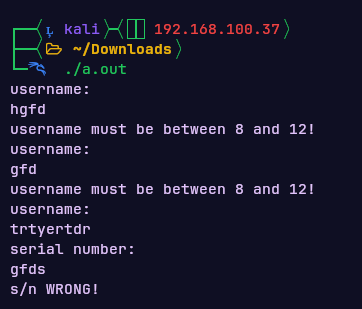
When you run the binary (./a.out):
- It prompts: “username:” (inferred from first puts at <+30> and your GDB run).
- You enter a string (up to ~128 chars, via fgets).
- It strips any trailing newline.
- Checks the length (post-strip): Must be 8 to 12 inclusive. If not, prints “wrong length!” (inferred) and loops back to prompt again (infinite retries).
- If length OK, prompts: “serial number:” (inferred from second puts at <+171>).
- You enter a floating-point number (via scanf “%lf”).
- Processes your username: Alternates case (even indices lowercase, odd uppercase).
- Takes the first 8 bytes of this processed string, interprets as integer via atoi.
- Converts that integer to double.
- Compares it (floating-point) to your entered serial number.
- If equal: Prints “s/n OK!” (confirmed in your GDB output at <+525>).
- If not: Prints “s/n WRONG!” (at <+539>).
- Exits with code 0.
Edge Cases
- Too short/long username: Loops forever with “wrong length!”.
- Non-numeric processed username: atoi returns 0 → enter “0” as serial to succeed.
- Negative numbers: Possible if username starts with ’-’ (e.g., “-1234567” → enter “-1234567”).
- Floating-point input: You can enter decimals (e.g., 123.0), but since the left side is integer-derived, fractional parts must match exactly (i.e., .0).
No anti-debugging, no encryption
Disassembly Breakdown
Disassembly Breakdown
The main function is ~577 bytes, with a loop for username processing and standard libc calls. I’ll group it into logical sections.
Setup and Canary (Stack Protection)
0x555555555289 <+0>:   endbr64               ; Intel CET (Control-flow Enforcement)
0x55555555528d <+4>:   push rbp
0x55555555528e <+5>:   mov rbp,rsp
0x555555555291 <+8>:   sub rsp,0x140         ; Allocate 320 bytes stack space
0x555555555298 <+15>:  mov rax,QWORD PTR fs:0x28  ; Load stack canary
0x5555555552a1 <+24>:  mov QWORD PTR [rbp-0x8],rax ; Store canary
0x5555555552a5 <+28>: xor eax,eax ; Clear EAX- Standard prologue: Sets up stack frame, allocates buffers.
- Buffers: [rbp-0x110] (username, ~128 bytes), [rbp-0x90] (processed username), [rbp-0x120] (first 8 bytes copy), [rbp-0x128] (serial double).
- Canary prevents stack overflows (checked at end).
Username Input Loop
0x5555555552a7 <+30>:  lea rdi,[rip+0xd5a]   ; Load "username:" string addr
0x5555555552ae <+37>:  call puts@plt
0x5555555552b3 <+42>:  mov rax,QWORD PTR [rip+0x2d56] ; stdout
0x5555555552ba <+49>:  mov rdi,rax
0x5555555552bd <+52>:  call fflush@plt       ; Flush output
0x5555555552c2 <+57>:  mov rdx,QWORD PTR [rip+0x2d57] ; stdin
0x5555555552c9 <+64>:  lea rax,[rbp-0x110]   ; Username buffer
0x5555555552d0 <+71>:  mov esi,0x80          ; Max 128 chars
0x5555555552d5 <+76>:  mov rdi,rax
0x5555555552d8 <+79>:  call fgets@plt        ; Read input
0x5555555552dd <+84>:  lea rax,[rbp-0x110]
0x5555555552e4 <+91>:  lea rsi,[rip+0xd27]   ; "\n" string
0x5555555552eb <+98>:  mov rdi,rax
0x5555555552ee <+101>: call strcspn@plt     ; Find newline pos
0x5555555552f3 <+106>: mov BYTE PTR [rbp+rax*1-0x110],0x0 ; Null out newline
0x5555555552fb <+114>: lea rax,[rbp-0x110]
0x555555555302 <+121>: mov rdi,rax
0x555555555305 <+124>: call strlen@plt      ; Get length
0x55555555530a <+129>: mov DWORD PTR [rbp-0x134],eax ; Store length
0x555555555310 <+135>: cmp DWORD PTR [rbp-0x134],0x7 ; If <=7
0x555555555317 <+142>: jle 0x555555555322 <main+153>
0x555555555319 <+144>: cmp DWORD PTR [rbp-0x134],0xc ; If >12
0x555555555320 <+151>: jle 0x555555555333 <main+170> ; Proceed if 8-12
0x555555555322 <+153>: lea rdi,[rip+0xcef]   ; "wrong length!"
0x555555555329 <+160>: call puts@plt
0x55555555532e <+165>: jmp 0x5555555552a7 <main+30> ; Loop back- Infinite loop until valid length.
- Uses fgets for safe input (no overflow risk).
- strcspn + null: Cleanly removes newline.
Serial Number Input
0x555555555333 <+170>: nop
0x555555555334 <+171>: lea rdi,[rip+0xd00]   ; "serial number:"
0x55555555533b <+178>: call puts@plt
0x555555555340 <+183>: mov rax,QWORD PTR [rip+0x2cc9] ; stdout
0x555555555347 <+190>: mov rdi,rax
0x55555555534a <+193>: call fflush@plt
0x55555555534f <+198>: lea rax,[rbp-0x128]   ; Serial double buffer
0x555555555356 <+205>: mov rsi,rax
0x555555555359 <+208>: lea rdi,[rip+0xcea]   ; "%lf" format
0x555555555360 <+215>: mov eax,0x0
0x555555555365 <+220>: call __isoc99_scanf@plt ; Read double
Prompts and reads a double (allows decimals, but int match needed).
Username Processing Loop
0x55555555536a <+225>: lea rax,[rbp-0x110]
0x555555555371 <+232>: mov rdi,rax
0x555555555374 <+235>: call strlen@plt       ; Re-get length (redundant?)
0x555555555379 <+240>: mov DWORD PTR [rbp-0x130],eax
0x55555555537f <+246>: mov DWORD PTR [rbp-0x13c],0x0 ; Processed idx = 0
0x555555555389 <+256>: mov DWORD PTR [rbp-0x138],0x0 ; Loop idx = 0
0x555555555393 <+266>: jmp 0x55555555541a <main+401> ; Check loop cond
[Loop body]
0x555555555398 <+271>: mov eax,DWORD PTR [rbp-0x138] ; idx
0x55555555539e <+277>: and eax,0x1           ; idx % 2
0x5555555553a1 <+280>: test eax,eax
0x5555555553a3 <+282>: jne 0x5555555553dd <main+340> ; If odd: toupper
[Even path]
0x5555555553a5 <+284>: ... tolower ...
[Odd path]
0x5555555553dd <+340>: ... toupper ...
[Common]
0x555555555413 <+394>: add DWORD PTR [rbp-0x138],0x1 ; idx++
0x55555555541a <+401>: mov eax,DWORD PTR [rbp-0x138]
0x555555555420 <+407>: cmp eax,DWORD PTR [rbp-0x130] ; idx < len
0x555555555426 <+413>: jl 0x555555555398 <main+271> ; Loop
0x55555555542c <+419>: mov eax,DWORD PTR [rbp-0x13c] ; processed len
0x555555555432 <+425>: cdqe
0x555555555434 <+427>: mov BYTE PTR [rbp+rax*1-0x90],0x0 ; Null terminate- Alternates case per position (even: lower, odd: upper).
- Builds in [rbp-0x90].
- Handles letters only; digits/symbols unchanged.
Final Processing and Comparison
0x55555555543c <+435>: lea rcx,[rbp-0x90]     ; Processed buf
0x555555555443 <+442>: lea rax,[rbp-0x120]    ; Copy buf
0x55555555544a <+449>: mov edx,0x8           ; 8 bytes
0x55555555544f <+454>: mov rsi,rcx
0x555555555452 <+457>: mov rdi,rax
0x555555555455 <+460>: call strncpy@plt      ; Copy first 8
0x55555555545a <+465>: mov BYTE PTR [rbp-0x118],0x0 ; Null at pos 8
0x555555555461 <+472>: lea rax,[rbp-0x120]
0x555555555468 <+479>: mov rdi,rax
0x55555555546b <+482>: call atoi@plt         ; Parse to int
0x555555555470 <+487>: mov DWORD PTR [rbp-0x12c],eax ; Store int
0x555555555476 <+493>: pxor xmm0,xmm0
0x55555555547a <+497>: cvtsi2sd xmm0,DWORD PTR [rbp-0x12c] ; Int to double
0x555555555482 <+505>: movsd xmm1,QWORD PTR [rbp-0x128] ; Load serial
0x55555555548a <+513>: ucomisd xmm0,xmm1     ; Compare doubles
0x55555555548e <+517>: jp 0x5555555554a4     ; If NaN/parity
0x555555555490 <+519>: ucomisd xmm0,xmm1     ; Re-compare (redundant?)
0x555555555494 <+523>: jne 0x5555555554a4    ; If not equal → fail
[Success]
0x555555555496 <+525>: lea rdi,[rip+0xbb1]   ; "s/n OK!"
0x55555555549d <+532>: call puts@plt
[Fail]
0x5555555554a4 <+539>: lea rdi,[rip+0xbab]   ; "s/n WRONG!"
0x5555555554ab <+546>: call puts@plt- strncpy + null: Ensures 8-char null-terminated string.
- atoi: Parses as signed int (handles ’-’, stops at non-digit).
- Float compare: Uses ucomisd (unordered compare) to handle NaN.
Cleanup
0x5555555554b0 <+551>: mov eax,0x0           ; Return 0
... canary check ...
0x5555555554c9 <+576>: leave
0x5555555554ca <+577>: ret
Exits cleanly.
Key Checks and Logic
- Length Check: 8 ≤ len ≤ 12 → Forces controlled input size.
- Processing: Alternate case doesn’t affect digits/symbols → Key for crafting numeric strings.
- Parsing: atoi on first 8 processed chars → Vulnerable to non-digits (defaults to 0 or partial parse).
- Comparison: Double equality → Exact match required, but integer-derived left side means serial must be integer-equivalent.
- No hashing or complex crypto → Purely didactic.
Strings
Strings (from RIP offsets, confirm with x/s in GDB):
- 0x555555556008: “username:”
- 0x555555556018: “wrong length!”
- 0x55555555603b: “serial number:”
- 0x555555555604a: “%lf”
- 0x55555555604e: “s/n OK!”
- 0x555555556056: “s/n WRONG!”
- 0x555555556012: “\n”
Legitimate Solutions
Craft username so processed first-8 parses to desired int N, then enter N as serial.
- Simple Positive: Username “12345678” → Processed unchanged → atoi=12345678 → Serial=12345678
- With Letters: Username “1a2b3c4d” → Processed “1A2B3C4D” → atoi=123 (stops at ‘A’) → Serial=123
- Negative: Username “-9999999” → atoi=-9999999 → Serial=-9999999
- Zero: Any non-starting-with-digit (e.g., “password”) → atoi=0 → Serial=0
- Max Length: “123456789abc” (12 chars) → First 8 “12345678” → Same as above.
Infinite possibilities — not a “fixed” key, but a relation between inputs.
Cracking with GDB (Bypassing Checks)
As you did:
- Break at <+523> (jne after compare).
- When hit: jump *main+525 → Skip to success puts.