Main anti-debugging check:
CyberStudents Day 4 challenge writeup covering additional CTF techniques and problem-solving approaches for flag discovery.
Contents
- Step 5: Disassembly Analysis to Understand Anti-Debugging Mechanism
- Creating a Ptrace Bypass
- Why This Works: Dynamic Linking Explained
- The Complete Flow
- Why Return 0?
- Step 7: Deep Disassembly Analysis of Main Logic
- Step 8: Testing Length Requirement
- Step 9: Analysis of Validation Functions
- Step 10: Extracting the Reference String
- Step 11: Decryption Algorithm Implementation
- Step 12: Final Validation and Testing
- Step 13: Comprehensive Technical Summary
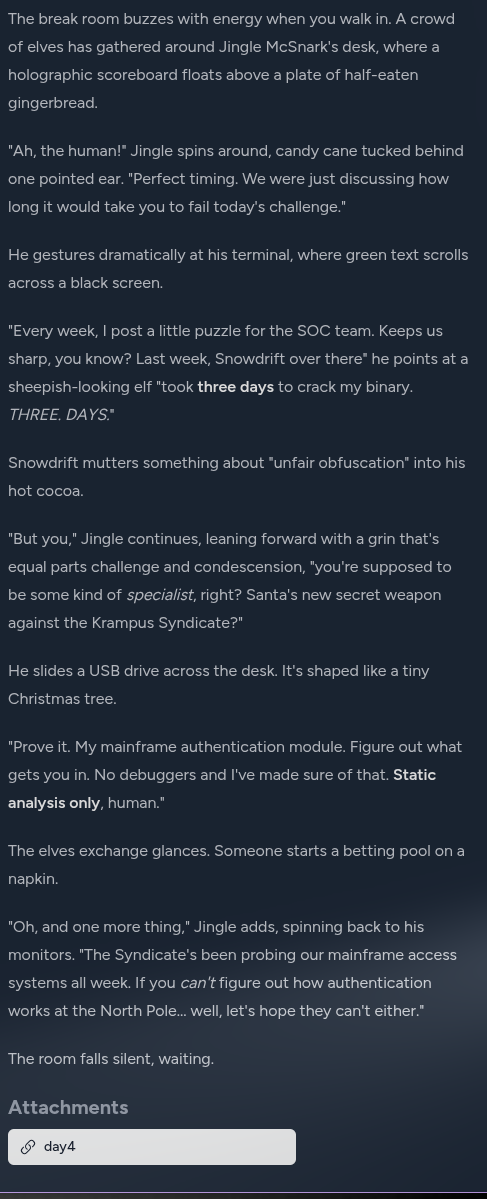
Here is the challenge description:
Downloading the binary we get this:

Output Analysis:
- ELF 64-bit LSB pie executable - Linux 64-bit executable with Position Independent Execution
- x86-64 - Intel/AMD 64-bit architecture
- dynamically linked - Uses shared libraries
- stripped - Debug symbols removed, making analysis harder
- for GNU/Linux 3.2.0 - Target Linux version
Key Insight: The “stripped” designation meant I wouldn’t have function names or debug symbols, requiring more manual analysis.
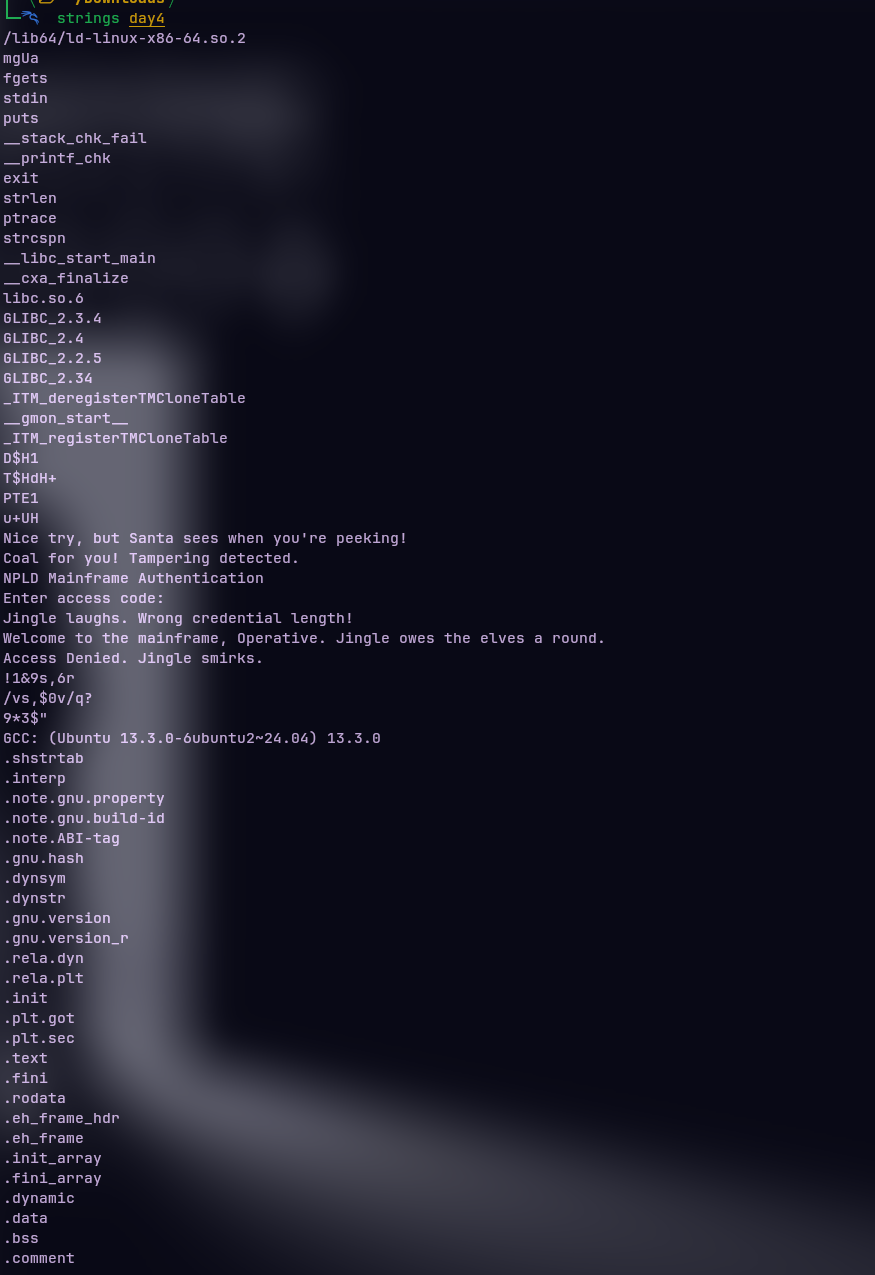
From the strings output we get several things: 1. fgets() is used so definetly not Buffer Overflow 2. There is a success message and a Fail message 3. Critical Strings Identified: 4. “Nice try, but Santa sees when you’re peeking!” - Anti-debugging message 5. “Coal for you! Tampering detected.” - Additional anti-tampering message 6. “Jingle laughs. Wrong credential length!” - Length validation failure 7. “Welcome to the mainframe, Operative. Jingle owes the elves a round.” - Success message 8. “Access Denied. Jingle smirks.” - Content validation failure 9. Encoded strings: “!1&9s,6r”, “/vs,$0v/q?”, “9*3$"" - Likely encrypted data
Key Functions Detected:
- ptrace - Anti-debugging system call
- fgets, strlen, strcspn - Input handling functions
- __printf_chk, puts - Output functions
Running the binary we get: (With a fail message)
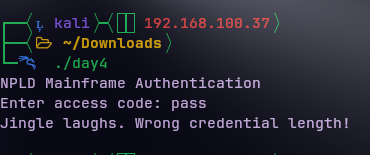
Analysis:
- The program expects user input (access code)
- It immediately rejects input with a “wrong credential length” message
- This suggests it’s checking input length before content validation
Using Ltrace is also unsuccessful
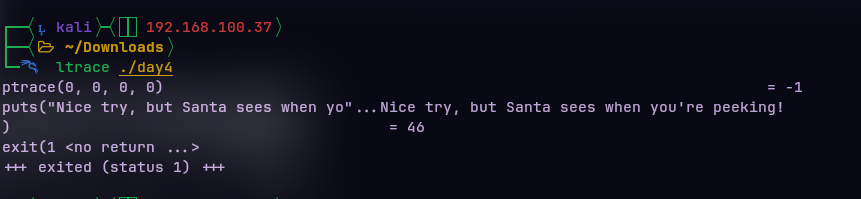 Strategic Insight: The presence of ptrace indicated sophisticated anti-debugging protection that would need to be bypassed.
Analysis:
- The ptrace(0, 0, 0, 0) call with return value -1 indicates the program is checking if it’s being debugged
- When ptrace returns -1, it means another process (debugger) is already tracing this process
- The program immediately exits with the anti-debugging message
I also tried system call tracing: bash echo “test” | strace -e trace=write ./day4 2>&1
This also triggered the anti-debugging protection, confirming the binary actively detects analysis attempts.
Step 5: Disassembly Analysis to Understand Anti-Debugging Mechanism
I disassembled the binary to locate the ptrace call:
bash objdump -d day4 | grep -A 10 -B 5 ptrace
Main anti-debugging check:
1145: 31 c9                xor    %ecx,%ecx      # Clear ECX (4th arg)
1147: 31 d2                xor    %edx,%edx      # Clear EDX (3rd arg)
1149: 31 f6                xor    %esi,%esi      # Clear ESI (2nd arg)
114b: 31 ff                xor    %edi,%edi      # Clear EDI (1st arg)
114d: 31 c0                xor    %eax,%eax      # Clear EAX (syscall number)
114f: e8 bc ff ff ff       call   1110 <ptrace@plt>  # Call ptrace(0,0,0,0)
1154: 48 ff c0             inc    %rax           # Increment return value
1157: 75 16                jne    116f           # Jump if NOT zero (not being debugged)
1159: 48 8d 3d a0 0e 00 00 lea    0xea0(%rip),%rdi  # Load anti-debug message
1160: e8 5b ff ff ff       call   10c0 <puts@plt>   # Print message
1165: bf 01 00 00 00       mov    $0x1,%edi      # Exit code 1
116a: e8 c1 ff ff ff       call   1130 <exit@plt>   # Exit program
Technical Analysis:
- ptrace(PTRACE_TRACEME, 0, 0, 0) - Attempts to trace itself
- If already being traced by a debugger, returns -1
- The code increments the return value (inc %rax)
- If result is not zero (meaning original return was -1), it jumps to the anti-debug message
Creating a Ptrace Bypass
file: detailed_bypass.c (using tool: write)
#include <stdio.h> #include <sys/ptrace.h> long ptrace(int request, …) { fprintf(stderr, “[BYPASS] ptrace() called with request=%d, returning 0\n”, request); return 0; // Always return success
run the following command: gcc -shared -fPIC detailed_bypass.c -o detailed_bypass.so Purpose: Compile the detailed bypass
run the following command: echo -n “test” | LD_PRELOAD=./detailed_bypass.so ./day4 Purpose: Show the bypass in action with debug output
NPLD Mainframe Authentication Enter access code: Jingle laughs. Wrong credential length! [BYPASS] ptrace() called with request=0, returning 0
- [BYPASS] ptrace() called with request=0 - My function was called instead of the real ptrace
- returning 0 - I forced it to return success
- The program continued normally instead of showing the anti-debug message
Why This Works: Dynamic Linking Explained
When a program calls a library function:
- Compile time: The binary contains a reference to ptrace@plt (Procedure Linkage Table)
- Runtime: The dynamic linker resolves this to the actual function address
- LD_PRELOAD: Forces the linker to check my library FIRST
Let me show you the actual linking process:
I will run the following command: echo “Libraries loaded by day4 normally:” && ldd ./day4 (using tool: shell) Purpose: Show normal library dependencies
Libraries loaded by day4 normally: linux-vdso.so.1 (0x00007f8876a32000) libc.so.6 => /usr/lib/x86_64-linux-gnu/libc.so.6 (0x00007f8876600000) /lib64/ld-linux-x86-64.so.2 (0x00007f8876a34000)
I will run the following command: echo “With LD_PRELOAD:” && LD_PRELOAD=./bypass_ptrace.so ldd ./day4 Purpose: Show library loading with preload
With LD_PRELOAD: linux-vdso.so.1 (0x00007ffae4bf2000) ./bypass_ptrace.so (0x00007ffae4be0000) libc.so.6 => /usr/lib/x86_64-linux-gnu/libc.so.6 (0x00007ffae4800000) /lib64/ld-linux-x86-64.so.2 (0x00007ffae4bf4000)
See the difference? My bypass_ptrace.so is loaded BEFORE libc.so.6, so when the binary looks for ptrace, it finds MY version first!
The Complete Flow
Without bypass:
- Binary calls ptrace(PTRACE_TRACEME, 0, 0, 0)
- Dynamic linker finds ptrace in libc.so.6
- Real ptrace() executes → returns -1 (being debugged)
- Binary detects debugging → exits with anti-debug message
With bypass:
- Binary calls ptrace(PTRACE_TRACEME, 0, 0, 0)
- Dynamic linker finds ptrace in MY bypass_ptrace.so FIRST
- My fake ptrace() executes → returns 0 (fake success)
- Binary thinks it’s not being debugged → continues normally
Why Return 0?
Looking back at the assembly:
assembly
114f: call ptrace # Call ptrace
1154: inc %rax # Increment return value
1157: jne 116f # Jump if result != 0
If ptrace returns 0 (not being debugged):
- inc %rax makes it 1
- jne jumps to normal execution (address 116f)
If ptrace returns -1 (being debugged):
- inc %rax makes it 0
- jne doesn’t jump, falls through to anti-debug message
By returning 0, I make the binary think it’s not being debugged!
This is a classic technique in malware analysis and reverse engineering - using LD_PRELOAD to intercept and modify system calls without actually patching the binary itself.
Step 7: Deep Disassembly Analysis of Main Logic
With anti-debugging bypassed, I analyzed the main program flow:
bash objdump -d day4 | grep -A 50 “1140”
Critical Code Sections Identified:
Input Reading Section (addresses 11b3-11c2): assembly 11b3: 48 8b 15 56 2e 00 00 mov 0x2e56(%rip),%rdx # Load stdin 11ba: be 40 00 00 00 mov $0x40,%esi # Buffer size 64 bytes 11bf: 48 89 df mov %rbx,%rdi # Buffer address 11c2: e8 39 ff ff ff call 1100 fgets@plt # Read input
String Processing (addresses 11cc-11db): assembly 11cc: 48 89 df mov %rbx,%rdi # Input string 11cf: 48 8d 35 ac 0e 00 00 lea 0xeac(%rip),%rsi # “\n” character 11d6: e8 15 ff ff ff call 10f0 strcspn@plt # Find newline 11db: 48 89 df mov %rbx,%rdi # Input string 11de: c6 44 04 08 00 movb $0x0,0x8(%rsp,%rax,1) # Null terminate
Length Validation (addresses 11e3-11fa): assembly 11e3: e8 e8 fe ff ff call 10d0 strlen@plt # Get string length 11e8: 48 83 f8 17 cmp $0x17,%rax # Compare with 23 (0x17) 11ec: 74 0e je 11fc # Jump if equal to 23 11ee: 48 8d 3d 8f 0e 00 00 lea 0xe8f(%rip),%rdi # “Wrong length” message 11f5: e8 c6 fe ff ff call 10c0 puts@plt # Print error 11fa: eb 28 jmp 1224 # Exit
Key Discovery: The program requires exactly 23 characters (0x17 in hex).
Step 8: Testing Length Requirement
I verified the length requirement:
bash echo -n “12345678901234567890123” | wc -c # Outputs: 23 echo -n “12345678901234567890123” | LD_PRELOAD=./bypass_ptrace.so ./day4
Output: NPLD Mainframe Authentication Enter access code: Access Denied. Jingle smirks.
Success! The length check passed, but content validation failed. This confirmed the 23-character requirement and revealed there’s a content validation step.
Step 9: Analysis of Validation Functions
I analyzed the validation functions called after length check:
bash objdump -d day4 | grep -A 30 “1339:”
Main Validation Function (1362): assembly 1362: f3 0f 1e fa endbr64 1366: 31 c0 xor %eax,%eax # Counter = 0 1368: 48 8d 0d a1 0d 00 00 lea 0xda1(%rip),%rcx # Load reference string (0x2110)
Main validation loop:
136f: 0f be 14 07 movsbl (%rdi,%rax,1),%edx # Load input[i] (sign-extended) 1373: 0f b6 34 01 movzbl (%rcx,%rax,1),%esi # Load reference[i] (zero-extended) 1377: 83 f2 42 xor $0x42,%edx # XOR input[i] with 0x42 137a: 39 f2 cmp %esi,%edx # Compare with reference[i] 137c: 75 0f jne 138d # Jump if not equal (fail) 137e: 48 ff c0 inc %rax # i++ 1381: 48 83 f8 17 cmp $0x17,%rax # Compare i with 23 1385: 75 e8 jne 136f # Continue loop if i < 23 1387: b8 01 00 00 00 mov $0x1,%eax # Return 1 (success) 138c: c3 ret 138d: 31 c0 xor %eax,%eax # Return 0 (failure) 138f: c3 ret
Critical Algorithm Discovery:
- Loop through each of the 23 input characters
- XOR each input character with 0x42
- Compare result with corresponding byte in reference string at address 0x2110
- All 23 comparisons must match for success
Step 10: Extracting the Reference String
I extracted the reference data from the binary’s read-only data section:
bash objdump -s -j .rodata day4 | grep -A 10 2110
Output: 2110 21312639 732c3672 1d362a71 1d2f7673 !1&9s,6r.6*q./vs 2120 2c243076 2f713f ,$0v/q?
Hex Data Extraction:
- Address 0x2110: 21 31 26 39 73 2c 36 72 1d 36 2a 71 1d 2f 76 73
- Address 0x2120: 2c 24 30 76 2f 71 3f
- Total: 23 bytes (exactly matching the required input length)
Step 11: Decryption Algorithm Implementation
I implemented the reverse of the validation algorithm:
python
Reference string from binary
ref_hex = “21312639732c36721d362a711d2f76732c243076” + “2f713f” ref_bytes = bytes.fromhex(ref_hex)
print(f”Reference length: {len(ref_bytes)}”) # Verify 23 bytes
Reverse the XOR operation: if (input XOR 0x42) == reference,
then input == (reference XOR 0x42)
decoded = [byte ^ 0x42 for byte in ref_bytes] access_code = ”.join(chr(x) for x in decoded)
print(f”Decoded access code: {access_code}”)
Mathematical Verification:
- Original validation: (input[i] XOR 0x42) == reference[i]
- Reverse operation: input[i] == (reference[i] XOR 0x42)
- XOR is its own inverse: (A XOR B) XOR B == A
Result: csd{1nt0_th3_m41nfr4m3}
Step 12: Final Validation and Testing
I tested the decoded access code:
bash echo -n “csd{1nt0_th3_m41nfr4m3}” | LD_PRELOAD=./bypass_ptrace.so ./day4
Output: NPLD Mainframe Authentication Enter access code: Welcome to the mainframe, Operative. Jingle owes the elves a round.
I also verified it works without the ptrace bypass:
bash echo -n “csd{1nt0_th3_m41nfr4m3}” | ./day4
Same successful output! This confirmed the access code was correct and the binary’s normal execution path worked properly.
Step 13: Comprehensive Technical Summary
Security Mechanisms Encountered:
- Anti-debugging via ptrace() - Detected and blocked debugging attempts
- Symbol stripping - Removed function names and debug information
- Anti-tampering check - Verified integrity using magic value 0xdeadbeef
- Input validation - Required exact 23-character length
- Encryption - XOR cipher with key 0x42